VMware vs Proxmox VE in 2026: what virtualization really costs now
Since Broadcom took over VMware, licences are sold per core, in bundles and by subscription only. We compare the yearly cost of a typical three-host cluster on VMware and on Proxmox VE, and list what to check before you switch.
For more than a decade, VMware vSphere was the safe default for running virtual machines. That changed when Broadcom closed its acquisition of VMware in November 2023. Two years on, many IT teams are opening their renewal quote, looking at the total, and asking whether an open-source platform such as Proxmox VE could do the same job for a fraction of the price.
This article explains what changed, compares the yearly cost of a typical cluster on both platforms, and lists what to check before you decide.
What changed in VMware licensing
- Subscription only. New perpetual licences are no longer sold, and support renewals for most perpetual products have ended. Hosts keep running, but patches and updates after your contract ends require a subscription.
- Per-core pricing. Licences are counted per physical CPU core, with a minimum of 16 cores per processor.
- A 72-core minimum. Since April 2025, partners report a minimum purchase of 72 cores per order. A small server with a single 8-core CPU is billed as if it had 72 cores.
- Bundles instead of products. Most standalone products were retired. Customers now choose mainly between VMware vSphere Foundation (VVF) and the larger VMware Cloud Foundation (VCF).
- A late-renewal penalty. Partners report a 20% surcharge when a subscription is renewed after its anniversary date.
The result: many customers report price rises well above 100%. In public court filings, a few large companies have alleged far higher increases for their own contracts.
How Proxmox VE is priced
Proxmox VE is open source (AGPLv3). Every feature, including clustering, high availability, live migration, Ceph storage and the built-in backup integration, is available for free. The optional subscription buys access to the tested Enterprise repository and to vendor support.
The subscription is counted per physical CPU socket, not per core. Current yearly prices from Proxmox:
| Plan | Price per socket per year | Support |
|---|---|---|
| Community | EUR 120 | Forum only |
| Basic | EUR 370 | 3 tickets, next business day |
| Standard | EUR 550 | 10 tickets, 4-hour response |
| Premium | EUR 1,100 | Unlimited tickets, 2-hour response |
A 64-core processor costs the same as an 8-core one.
A worked example: three hosts
Take a common small or mid-size setup: three servers, each with two 16-core CPUs. That is 6 sockets and 96 cores.
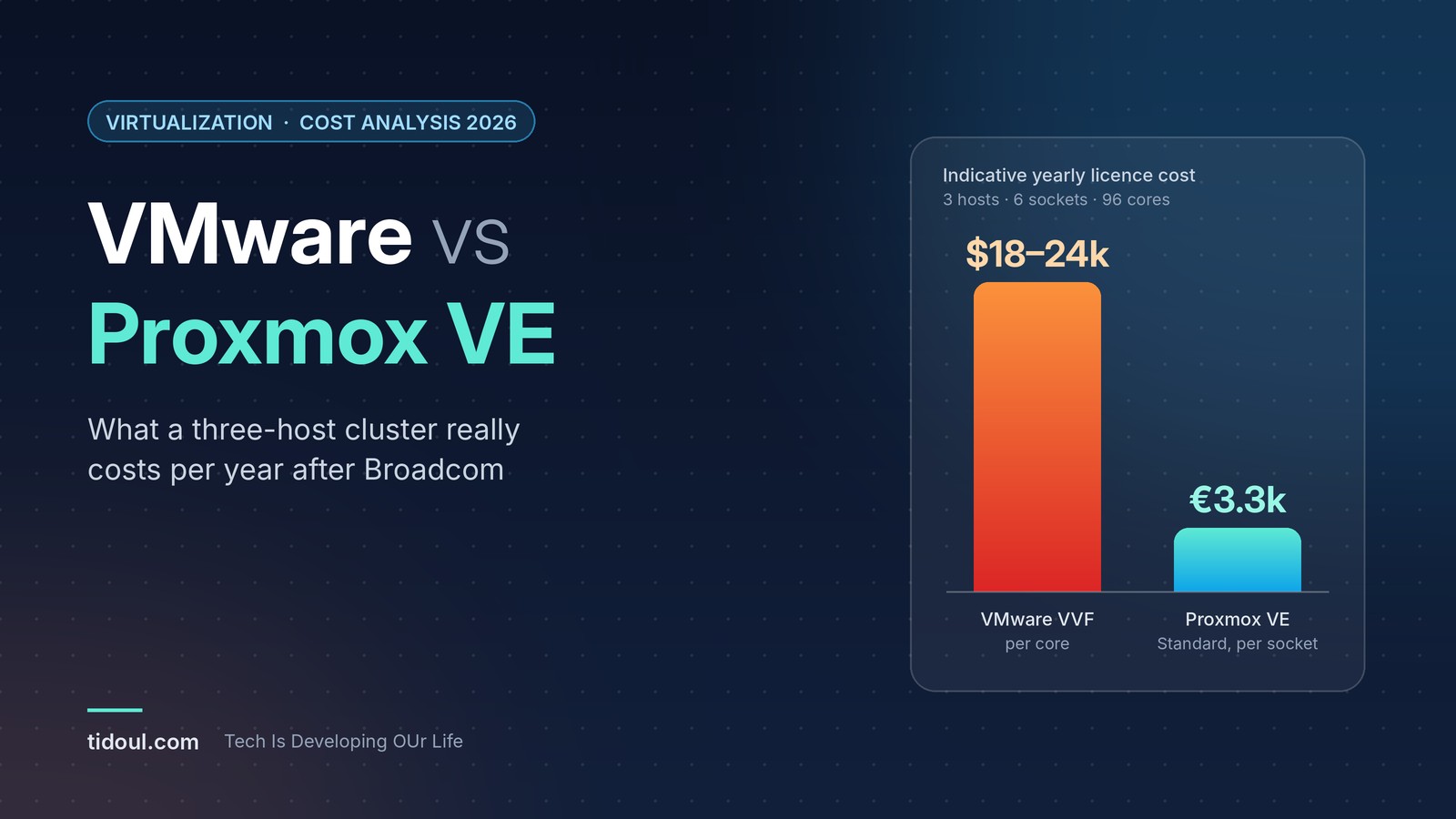
- VMware vSphere Foundation: market prices reported by partners in 2026 sit around USD 190 to 250 per core per year. For 96 cores, that is roughly USD 18,000 to 24,000 per year, before any late-renewal penalty. VCF costs more.
- Proxmox VE Standard: 6 sockets at EUR 550 is EUR 3,300 per year, with the same feature set on every node. Basic support would cost EUR 2,220.
For a single small server with one 8-core CPU, the gap is even wider: VMware’s 72-core minimum still applies, while Proxmox VE Standard costs EUR 550.
These are indicative figures. VMware prices are negotiated through partners and vary by region, term and bundle. Always ask for a written quote.
Licences are not the whole bill
A lower licence cost does not automatically mean a lower total cost. Before you migrate, look at:
- Skills. Proxmox VE is built on Debian Linux, KVM and LXC. Your team needs to be comfortable with Linux administration.
- Backup. Check that your backup software supports Proxmox VE, or plan for Proxmox Backup Server.
- Storage. vSAN does not move across. Ceph, ZFS, or your existing SAN or NAS over iSCSI or NFS are the usual options.
- Application support. Some vendors only certify their software on specific hypervisors. Ask them first.
- Migration effort. Proxmox VE includes an import wizard for VMware ESXi virtual machines, but every VM still needs testing, driver changes (VirtIO) and a planned downtime window.
Our advice
- Do not let your VMware subscription lapse by accident. Know your renewal date so you avoid the late-renewal penalty while you evaluate options.
- Count your sockets and cores today. It takes ten minutes and shows you the real gap for your own servers.
- Start with a pilot. Move a few non-critical workloads to a small Proxmox VE cluster and run it for a few weeks.
- Plan the migration in waves. Begin with simple VMs, keep business-critical systems for last, and keep a rollback plan for each wave.
For many small and mid-size companies, Proxmox VE now delivers what they used from vSphere at a much lower and far more predictable cost. For others, deep integration with VMware tools still justifies the price. The right answer depends on your workloads, your team and your contracts.
TIDOUL designs, migrates and supports Proxmox VE and Ceph clusters. If you want a cost comparison based on your own servers, contact us.